
Somali Public Agenda
March 4, 2026
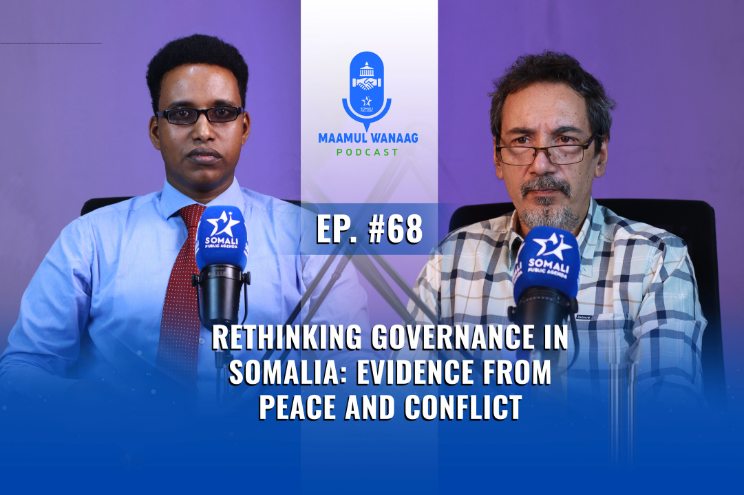
E68. Rethinking Governance in Somalia: Evidence from Peace and Conflict Research I Maamul Wanaag Podcast
State-building efforts in Somalia have faced persistent challenges for decades. In this episode, we speak with a leading researcher from the London School of Economics about the realities of governance in Somalia. Drawing on extensive fieldwork across the country and the conclusion of a second major research programme, we discuss how political authority is exercised, how local and national dynamics shape governance, and what recent research suggests about Somalia’s future.
In this 68th episode of the Maamul Wanaag Podcast, Mahad Wasuge speaks with Dr. Nisar Majid, Research Director at the London School of Economics and Political Science (LSE) PeaceRep programme. They discuss conflict and governance dynamics in Somalia, as well as insights from the Conflict Research Programme and the PeaceRep (Peace and Conflict Resolution Evidence Platform) programme, both of which Dr. Nisar Majid has led.
Click here to listen the podcast on Apple Podcasts, YouTube and Amazon Music.



Dear Mahad and Dr Nisar,
Good analysis on governance in Somalia. Congratulations. The three levels of fragmentation namely the tensions between national and sub-national governments, the disparities between urban and rural areas, and the influence of Al-Shabaab (AS) are all valid and important observations. However, AS governance did not come out clearly. Perhaps it was deliberately avoided and even not mentioned in a subtle manner. Yet any serious discussion on governance in Somalia must acknowledge the administrative and regulatory structures that Al-Shabaab has established in areas under its control.
On the point on Rural and Urban characteristics – Humanitarian and development aid appear to be overly concentrated in urban areas. Many studies conducted by the Somali Public Agenda (SPA) and other independent researchers tend to focus primarily on urban centres. As a result, humanitarian and development actors find it easier to access data and design projects in cities, whereas rural areas remain under-researched and underserved. Additionally, many gatekeepers and intermediaries are based in urban areas where the return on investment (ROI) is perceived to be higher, further limiting opportunities for meaningful support to rural communities.
On the concept of “city-states,” the case of Kismayo presents a different picture compared to other cities. Although large pockets of Jubaland remain under Al-Shabaab control forcing investments to concentrate in Kismayo—it raises an interesting question: why do people for example in Puntland still predominantly invest in the capital, Garowe, rather than in other peaceful locations across Puntland?
I also somewhat disagree with the idea of justice in Jubaland as presented in the discussion. There seems to be a degree of oversimplification regarding justice in Kismayo, which could be a dangerous conceptual shortcut. Justice should be linked to the broader concept of development, and as we know, development across Jubaland as a whole remains limited.
This raises important questions: How do we measure justice and justice provision in a context where political space is constrained? Should justice be promoted as a pathway to expanding political space, or must political space first be opened to enable genuine justice systems? For instance, I followed the incident involving Ahmed Madobe ordering the killing of seven individuals from his own clan to demonstrate the enforcement of justice. While this episode may be interpreted by some as evidence of impartial justice, it could also be viewed as an outlier and should not be used to generalize or justify broader claims about justice provision in Jubaland.
That said, I do agree with the emerging thinking around reimagining the state-building / peacebuilding process in Somalia. The concept of a “New Arta process” sounds interesting. However, such an initiative should ideally be undertaken on a voluntary basis rather than being overly tied to projectized funding structures. You know what I mean!
Too often, our most promising ideas such as attempts to revive or refashion the Arta process fail to materialise because they quickly become “projectised.” In many cases, discussions shift prematurely toward funding opportunities rather than focusing on the potential political or societal impact of the initiative. Instead, it may be more effective to bring together like-minded Somali and non-Somali scholars and practitioners who are willing to contribute voluntarily to such an initiative. These groups could include former UN officials and government leaders who are now financially secure often earning pensions and therefore less driven by personal gain. A good example, if I may mention, is Dr Christoph Jaeger, who continues to support the Somali government largely on a voluntary basis. He strongly recommended that the Somali Public Agenda dialogue platform be conducted largely on a voluntary basis, with only minimal funding for local organizational support. Ah sounds like a caricature idea according to many.
All the best,
Jamal
Dear Jamal,
Many thanks for your thoughtful responses. I tend to agree with all of the points you raise! It’s difficult in a limited time to cover all issues to an adequate level and definitely many of the issues and questions you raise deserve further in-depth discussion.
I especially support your point on the urban bias in both aid and research terms and I frequently raise it in different fora, and acknowledge it as a limitation in the work we have done.
Justice in Kismayo, Jubbaland and Somalia as a whole is important to discuss. In my remarks I was referring to this report – https://peacerep.org/publication/mapping-the-fragments-justice-and-security-in-somalia-galkayo-and-kismayo/ – which provides a more detailed comparison.
And I’m glad you like the idea of a new Arta process and again, I fully agree that if such a process gets traction it is important not to ‘projectise’ it and to draw on a range of stakeholders to inform something along those lines.
Thanks, Nisar