Share This
Facebook
Twitter

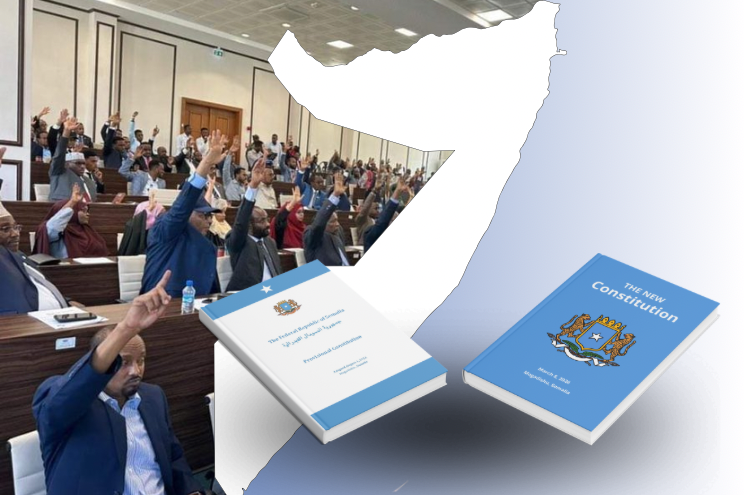
On 4 March 2026, a joint session of the two chambers of Somalia’s federal parliament approved amendments to 11 chapters of the Provisional Federal Constitution, as well as three articles in Chapter 2 and three articles in Chapter 4. The Speaker of the House of the People (HoP), who chaired the session, announced that the constitutional review process was finally concluded and that the new version would effectively become the country’s official federal constitution. Four days later, on 8 March, the President signed the new constitution.
This is a significant development in Somalia’s political settlement. The constitutional review process has long been seen as a key tool for political reconciliation. The executives of the Federal Government of Somalia (FGS) and the Federal Member States (FMS) were expected to agree on contentious political issues, which would then provide the foundation for amendments made by the constitutional review bodies: the Parliamentary Oversight Committee (OC) and the Independent Constitutional Review and Implementation Commission (ICRIC).
Five key political agreements have been signed during the term of President Hassan Sheikh Mohamud: (1) the allocation of powers (December 2022); (2) the judicial model (December 2022); (3) fiscal federalism (March 2023); (4) the National Security Architecture (March 2023); and (5) elections (May 2023). However, although these agreements informed the review of contentious constitutional issues, they were not widely seen as reflective of a broader political consensus, as they all favored the center over the periphery. Puntland, a key Federal Member State, was not part of any of these agreements.
Now that the FGS has concluded the constitutional review process, the key question is which constitution is legitimate—the Provisional Federal Constitution or the recently amended version—and how this development will affect the upcoming electoral process.
Since the approval of the Provisional Federal Constitution in August 2012, the FGS, FMS, and opposition actors have been the primary participants in electoral processes. The 2012 selection of the 275 members of parliament who elected the President, as well as the 2016–17 and 2021–22 indirect elections, had many flaws. Corruption, preventing politicians from competing, handpicking electoral delegates, and selecting loyalists as members of election management bodies were just some of these flaws.
However, the outcomes were accepted as legitimate. Politicians who won these controlled processes were broadly accepted as members of the House of the People (HoP) and the Upper House (UH). Presidents who won presidential contests through various means, including “bribery,” were accepted as legitimate presidents for a four-year mandate. The broad acceptance of the outcomes of these electoral processes made the imperfect process both acceptable and legitimate.
The constitutional amendment process is different. The outcome—the new federal constitution—does not have the acceptance of key political stakeholders, including two Federal Member States, Puntland and Jubaland, as well as opposition political actors, including former presidents, former prime ministers, and other influential politicians. Unlike the flawed electoral processes, there is a legitimacy deficit in the constitutional amendment and completion process.
This primarily stems from the perception that the changes made to the constitution limit opportunities for presidential competition and centralize significant executive powers. For instance, Articles 106 and 107 of the new constitution condition presidential candidates to have lived in Somalia for the past five years and require that they be nominated by a political party or a coalition of parties, particularly the three political parties with the highest number of seats in parliament. For many, this limits competition in a country where more than 40 candidates registered for the presidency in 2022.
We do not expect the opposition or the two Federal Member States to change their positions. Their stance remains that they recognize only the 2012 Provisional Federal Constitution and that the next electoral transition should be based on that constitution.
The process that led to the completion of the constitutional review also raised a number of legal and procedural questions. First, nearly 50 members of parliament were banned from participating, as their intention was reportedly to block any opportunity to discuss the amended articles and chapters. Second, parliament spent only a few weeks discussing 11 chapters, and the discussions occurred during a period when the parliamentary session was extended without a formal request from the President. Finally, members of parliament questioned whether there was a quorum in both chambers when they voted on the final approval of the amended chapters on 4 March.
For instance, Hon. Abdirahman Abdishakur stated in a commentary he recently published: “The session was attended by 161 members of the House of the People and 34 senators, falling short of the constitutional requirement.” The quorum required for constitutional amendments is two-thirds of each chamber—184 members of the House of the People and 36 senators.
Rather than serving as a political reconciliation tool, the constitutional review process now reflects an approach in which the winners set the rules of the game, with significant implications for Somalia’s future political settlement. Although presidents who emerged from imperfect indirect electoral processes have previously attempted to set the rules of the game—particularly the predecessor of the current president—the current government has advanced such an approach by using the constitutional review process in this way. The key question is: if the amendments are not accepted as legitimate, where does this leave Somalia?
Unlike indirect elections, the outcome of the constitutional amendment process has not been widely accepted as legitimate. This effectively means that Somalia now has two federal constitutions.
This situation has major implications for upcoming federal elections. The federal parliament leadership, citing the new constitution, contends that it has one year remaining in its mandate, as the new constitution stipulates that the parliament and the president have five-year terms. Other political actors, citing the 2012 Provisional Federal Constitution, argue that the four-year mandate of the federal parliament ends on 14 April and that of the President ends on 15 May this year.
There are two possible ways forward to address this situation. The first would be to begin dialogue on the new constitution with the opposition and the two Federal Member States (Jubaland signed the political agreements that informed the process before it withdrew from the National Consultative Council (NCC) in October 2024), so that they can propose amendments and changes to the articles that concern them. These changes would then be submitted to parliament for review and approval. This approach faces two challenges: the incumbent federal government may be unwilling to do so, and the parliamentary mandate ends in April.
The second approach would be to revert to the 2012 Provisional Federal Constitution and use it as the legal foundation for the upcoming political transition. This option may be easier than the first, as it is the same constitution under which the incumbent federal leaders were elected and which the opposition considers legitimate. However, the main challenge would again be the position of the FGS, which has invested heavily in the new constitution.
If neither of these paths is followed, the only remaining option—likely the worst-case scenario for Somalia—would be the emergence of a parallel political process starting outside Mogadishu, probably in Puntland and Jubaland, while the FGS strengthens its control of Mogadishu and the surrounding regions.
Somalia cannot afford parallel governments. Now is the time for the international community, Somali intellectuals, and civil society to play a constructive role in helping Somalia manage this difficult constitutional and electoral conundrum.

Somali Public Agenda (SPA) is a non-profit, non-partisan, and independent public policy and administration research and action organization based in Mogadishu. It aims to advance understanding and improvement of public policy and services in Somalia through evidence-based research and analysis, dialogue, policy and service design, and training.
Stay updated on governance and public services in Somalia!