Share This
Facebook
Twitter

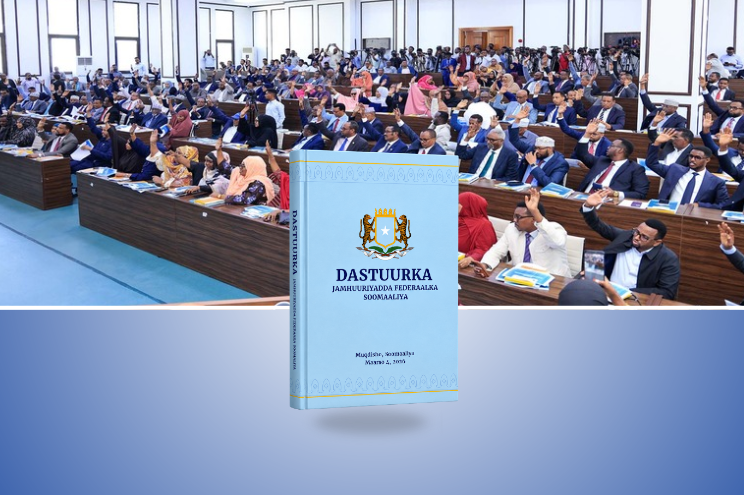
On 4 March 2026, a joint sitting of the two chambers of Somalia’s Federal Parliament approved amendments to 11 chapters of the Provisional Federal Constitution, alongside revisions to three articles in Chapter 2 and three articles in Chapter 4. The sitting was chaired by the then Speaker of the House of the People, Sheikh Adan Mohamed Nur (Adan Madoobe), who currently serves as Leader of Southwest State. Following the approval, he declared the constitutional review process concluded and stated that the revised document would serve as Somalia’s official Federal Constitution. Four days later, on 8 March 2026, President Hassan Sheikh Mohamud signed the amended Constitution into law. The revised Constitution formally entered into force on 14 April 2026, one month after its publication in the Official Gazette.
According to the Federal Government, the new Constitution is intended to resolve many of the contradictions, ambiguities and contentious issues that have characterised Somalia’s Provisional Constitution. However, the process through which it was amended, reviewed and approved has been criticised by opposition groups inside and outside Parliament, as well as by the Federal Member States (FMS) of Puntland and Jubaland. These actors have questioned the transparency, inclusiveness and legitimacy of the amendment process.
This commentary examines key developments in the implementation of Somalia’s newly adopted constitutional framework six months after its entry into force. It focuses on compliance with constitutional provisions during the transitional period, the exercise of federal authority, progress in institutional reforms, and the role of the judiciary in upholding constitutional obligations and ensuring compliance with electoral requirements.
The Early Application of the Constitution and Questions of Legal Authority
On 5 March 2026, one day after Parliament approved the revised chapters of the Federal Constitution, the Office of the President hosted a dinner ceremony to mark the occasion. During the ceremony, the President expressed his appreciation to Parliament for approving the constitutional review and amendments. The then Speaker of the House of the People, Adan Mohamed Nur (Adan Madoobe), subsequently declared that the revised Constitution had come into effect that evening. Under the newly adopted constitutional provisions, this declaration was interpreted as extending the mandates of the current Parliament and President by an additional year.
However, on 5 November 2026, the Supreme Court delivered its judgment on an appeal filed by former President Sheikh Sharif Sheikh Ahmed, challenging the constitutional amendment process and the implementation of the revised Constitution. Although the Court rejected the appeal concerning the constitutional review and amendment process, it ruled that the terms of the current Parliament and President had expired on 14 April and 15 May 2026, respectively. By reaffirming these original expiry dates, the Court effectively rejected the one-year extension of the mandates of the current Parliament and President.
Federal Intervention in Southwest State and the Question of Constitutional Legitimacy
A further significant development concerned the political dispute between the Federal Government of Somalia and the leadership of the then Southwest State administration.
Following the adoption of the new Constitution, Southwest State formally suspended relations with the Federal Government and proceeded with its own indirect electoral process. The dispute subsequently escalated into a confrontation involving federal security forces. The Federal Government deployed military forces in an effort to remove the existing Southwest State administration and replace it with new leadership through the process set out in the new Constitution and related laws.
According to a press release issued by the Office of the Prime Minister on 1 April 2026, the Prime Minister appointed Jabril Abdirashid, the Second Deputy Prime Minister, as the transitional leader of Southwest State. The appointment was justified by reference to provisions of the newly adopted Federal Constitution, particularly Article 120(6), (7) and (8). The Federal Government also invoked Articles 73(1) and 75(1), which concern the circumstances in which federal intervention in FMSs may be permitted.
Of particular constitutional significance is the timing of the Federal Government’s reliance on these provisions. The Prime Minister’s announcement was issued on 1 April 2026, whereas the Constitution formally entered into force on 14 April 2026. This raises questions about the legal basis for invoking provisions of a Constitution that had not yet formally entered into force. It also highlights the broader need for clarity regarding the commencement and application of constitutional provisions during periods of political transition.
Progress and Gaps in Establishing Constitutional Institutions
On 17 May 2026, during a meeting of the Federal Government’s Council of Ministers chaired by the Prime Minister, the Ministry of Justice and Constitutional Affairs presented a plan for implementing the newly adopted Constitution.
The implementation plan outlined measures for establishing key constitutionally mandated institutions, including the High Judicial Council, the Constitutional Court, the Independent Anti-Corruption Commission, the Somali Revenue Authority, and the Commission for Revenue Sharing and Distribution.
Subsequently, at its meeting on 16 July 2026, the Council of Ministers approved the draft bill establishing the Somali Revenue Authority. On 6 August 2026, pursuant to Article 145 of the new Federal Constitution, the Council of Ministers appointed four members of the High Judicial Council. However, their appointments had not yet received the required approval from both Houses of Parliament. These measures represented important steps towards implementing the institutional reforms envisaged under the new constitutional framework.
However, the establishment of the other institutions identified in the implementation plan, including the Constitutional Court, the Independent Anti-Corruption Commission and the Commission for Revenue Sharing and Distribution, remained pending. Delays in establishing these bodies raise questions about the pace, sequencing and prioritisation of constitutional implementation, particularly given the role these institutions are expected to play in supporting accountability, judicial independence and intergovernmental relations.
Judicial Oversight and the Conduct of State Elections
The Federal Supreme Court’s involvement in the electoral process in Galmudug State provides another important test of the new constitutional framework, particularly the role of judicial oversight in ensuring compliance with electoral requirements.
On 30 July 2026, simultaneous elections for the House of Representatives and local councils were held in Galmudug State under the administration of the National Independent Electoral and Boundaries Commission (NIEBC).
Following the elections, but before the final results were declared, the Federal Supreme Court received an electoral appeal filed by Towfiiq, a political association that had participated in the process. The appeal challenged the administration and conduct of the elections. Pursuant to Article 130 of the Federal Constitution, the Supreme Court, as the country’s highest judicial authority, exercised its constitutional jurisdiction to hear and adjudicate the dispute.
After hearing the case and examining the allegations, the Court determined that the elections held on 30 July 2026 had not been administered or conducted in accordance with the Constitution and applicable electoral laws. Pursuant to Article 82 of the Electoral Law and the constitutional principles of free, fair and transparent elections, the Court declared the election results null and void.
On 30 September 2026, the NIEBC conducted rerun elections in Galmudug State. The rerun took place without the participation of the Towfiiq political association. On the same day, the Commission also conducted elections in Hirshabelle State.
The Commission announced the preliminary results of the Galmudug elections on 2 October 2026 and those of the Hirshabelle elections on 3 October 2026. Under the applicable electoral framework, the final determination of election results falls within the jurisdiction of the Supreme Court, which is required to issue its determination within 14 days of formally receiving the preliminary results submitted by the Commission.
The Supreme Court subsequently announced its approval of the final results of the elections to the Houses of Representatives of Galmudug and Hirshabelle States on 13 October and 19 October 2026, respectively. However, the Court’s announcements covered only the elections to the Houses of Representatives and did not include the results of the local council elections in either state. These results remained outstanding, pending final judicial determination at the time of writing.
One of the issues underlying the disputes surrounding the local council elections concerned the legality of the electoral process conducted by the NIEBC. Specifically, Article 19(4) of the Electoral Law stipulates that elections must be held only in districts that existed as of 31 December 1990. However, the NIEBC reportedly conducted elections in several districts that did not meet this legal requirement, raising concerns about the conformity of the electoral process with the provisions of the Electoral Law.
The Expiration of the Transitional Period and Unresolved Constitutional Obligations
On 7 October 2026, the Independent Constitutional Review and Implementation Commission (ICRIC) issued a press release concerning the expiration of the six-month transitional period established under the 2026 Federal Constitution.
The transitional period commenced on 14 April 2026, when the Constitution formally entered into force, and was scheduled to expire on 14 October 2026. Its primary purpose was to ensure that existing administrative arrangements, institutional structures and governmental practices were brought into conformity with the new constitutional framework.
According to the ICRIC’s statement, Articles 81(1)(f) and 117(3)(a) of the Constitution were due to take effect on 14 October 2026. These provisions establish a separation between parliamentary membership and ministerial office by prohibiting individuals from simultaneously serving as Members of Parliament and members of the Council of Ministers.
Consequently, individuals who simultaneously hold ministerial and parliamentary positions are required to choose between the two offices and relinquish one of them, in accordance with the relevant constitutional provisions. Similarly, a Member of Parliament who accepts another government position must relinquish their parliamentary seat, as required by the Constitution.
In response to the expiration of the transitional period, the Council of Ministers convened an extraordinary meeting chaired by the Prime Minister to deliberate on implementing the Constitution and aligning the existing legal and institutional framework with its provisions. During the meeting, the Council determined that an additional two months would be necessary to facilitate implementation. It also established a ministerial committee, chaired by the Minister of Justice and Constitutional Affairs, to prepare a new executive act to replace the existing framework dating from 1968.
However, the Council’s deliberations and subsequent decisions did not explicitly address the constitutional provisions prohibiting the simultaneous holding of parliamentary and ministerial positions. Nor did they clarify the implications for officials currently serving in both capacities. Consequently, questions remain about how these provisions will be implemented following the expiration of the constitutional transitional period.
The Risks of Selective Constitutional Implementation
Taken together, these developments suggest that implementation of the 2026 Constitution has been uneven and, at times, selective rather than comprehensive. Federal authorities invoked constitutional provisions to justify decisions concerning the leadership of Southwest State before the Constitution formally entered into force. Progress has been made towards establishing some institutions mandated by the new Federal Constitution, but several important bodies remain unestablished. The electoral process has also exposed both the importance of judicial oversight and the challenges of ensuring that all stages of elections are conducted and concluded in accordance with the Constitution and electoral laws. Meanwhile, the expiration of the transitional period has not been accompanied by clear action to address the constitutional incompatibility between parliamentary and ministerial office.
The central challenge, therefore, is not simply whether the new Constitution contains provisions intended to resolve longstanding governance disputes, but whether those provisions are applied consistently by all state institutions and political actors. Selective or politically contingent implementation risks weakening the authority of the Constitution and undermining public confidence in the constitutional order.
This risk could become particularly acute if a future election brings an opposition candidate to the presidency, especially if that candidate or the political forces supporting them reject the legitimacy of the new Constitution. In such a scenario, a new administration could seek to challenge, reinterpret or delay the implementation of provisions adopted under the current government, potentially triggering renewed institutional and federal–state disputes. Preventing such an outcome requires an inclusive political understanding of the Constitution’s legitimacy, followed by consistent implementation, respect for judicial decisions and the timely establishment of the institutions it mandates.
This commentary is a product of Somali Public Agenda’s (SPA) Wada-hadal Qaran: Strengthening Evidence-Based National Dialogue and Cooperative Governance in Somalia project. Wada-hadal Qaran is a two-year initiative that seeks to strengthen evidence-informed public dialogue and civic engagement on governance issues through research, dialogue, capacity development and public engagement.
Denmark, Sweden and the Netherlands support this work through the Civic Engagement Facility (CEF). SPA retains full editorial independence. The views expressed in this commentary are those of SPA and do not necessarily reflect the views of the CEF or its donors.

Abdinasir Ahmed Ali is the SPA Dialogue Director at Somali Public Agenda (SPA).


Somali Public Agenda (SPA) is a non-profit, non-partisan, and independent public policy and administration research and action organization based in Mogadishu. It aims to advance understanding and improvement of public policy and services in Somalia through evidence-based research and analysis, dialogue, policy and service design, and training.
Stay updated on governance and public services in Somalia!