Share This
Facebook
Twitter

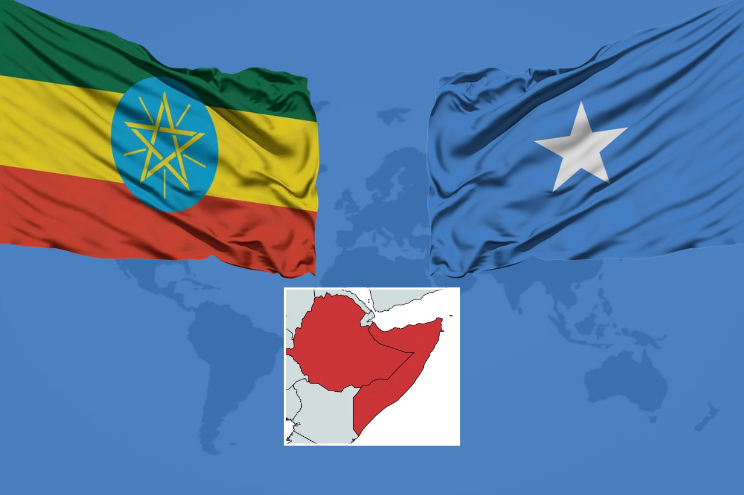
The Horn of Africa (HoA) is characterized by volatile political dynamics and interconnected conflicts that increasingly transcend national borders. State fragility, elite power struggles, regional competition, the internationalization of internal conflicts, transnational terrorist organizations, and external interference contribute to instability across the region. These dynamics undermine governments’ capacity to address poverty and meet citizens’ needs, while exacerbating social divisions and regional insecurity. Ethiopia’s emerging internal conflict and shifting geopolitical alignments are particularly consequential for the region. This commentary examines their potential implications for Somalia’s security, domestic political landscape, and foreign policy, focusing on the risks they pose and the strategic opportunities they may create.
Ethiopia’s Emerging Internal Conflict and Shifting Geopolitical Alignments: Key Developments
On September 20, 2026, seven Ethiopian armed groups announced the formation of an alliance aimed at overthrowing Prime Minister Abiy Ahmed’s government. Reported on September 21, the alliance, known as the Ethiopian Peoples’ Forces Alliance for Survival (or the Alliance for Survival), brings together the Tigray People’s Liberation Front (TPLF), Amhara Fano National Movement (AFNM), Oromo Liberation Army (OLA), Ogaden National Liberation Front (ONLF), an Afar armed group, Benishangul Peoples’ Liberation Movement, and Gumuz Peoples’ Democratic Movement (GPDM). The groups accused the federal government of centralizing power, marginalizing regional communities, and presiding over widespread conflict, poverty, and abuses. They called for the removal of the government and the establishment of a transitional government. However, the alliance’s membership and level of coordination remain uncertain, with some groups and factions disputing their participation. Its formation nevertheless signals a potentially significant shift in Ethiopia’s conflict dynamics and raises concerns about the country’s political stability, with possible repercussions across the Horn of Africa, particularly Somalia.
The emerging conflict differs significantly from the 2020–2022 Tigray War. The formation of an alliance among previously competing armed groups suggests a shift in the conflict landscape, with former adversaries increasingly united against the federal government. During the Tigray War, Eritrean forces and non-state armed groups, including the Amhara Fano National Movement (AFNM) and the Oromo Liberation Army (OLA), fought alongside the Ethiopian government against the Tigray People’s Liberation Front (TPLF). Their emerging alignment against the federal government could further complicate Ethiopia’s internal security environment and increase the risk of prolonged instability.
The conflict is also taking on a broader geopolitical dimension. Ethiopia has accused neighboring countries, including Egypt, Eritrea, and Sudan, of supporting insurgent groups, allegations that these countries have rejected. Sudan, in turn, has accused Ethiopia of supporting the Rapid Support Forces (RSF). Meanwhile, Israel and the United Arab Emirates (UAE) maintain strategic ties with Ethiopia. These competing regional alignments heighten the risk that Ethiopia’s internal conflict could become intertwined with wider geopolitical rivalries, potentially triggering regional spillover, particularly into Eritrea. Following his re-election, Prime Minister Abiy Ahmed reiterated Ethiopia’s commitment to securing maritime access, including through Eritrea’s port of Assab. President Hassan Sheikh Mohamud’s participation in the Alamein Summit in Egypt, meanwhile, underscored Somalia’s growing engagement with Eritrea, Egypt, and Sudan. These developments suggest that Ethiopia’s internal conflict and regional competition are increasingly interconnected, creating a more complex strategic environment for Somalia.
Possible Implications of Ethiopia’s Current Conflict for Somalia
Ethiopia’s renewed conflict, with concerns that it could extend into neighboring Eritrea, could have far-reaching implications for the Horn of Africa, particularly Somalia. Given the close interconnection between the two countries’ security environments and the increasingly competitive regional geopolitical landscape, developments in Ethiopia could affect Somalia in multiple ways. This commentary examines three principal dimensions: security, domestic politics, and foreign policy.
Ethiopia’s internal conflict has direct implications for Somalia’s security because Ethiopian forces play a significant role in the country’s security architecture. Ethiopian troops operate under the African Union Support and Stabilization Mission in Somalia (AUSSOM) and bilateral defense cooperation arrangements with successive federal governments in Mogadishu. Their presence in Hiiraan, Bay, Bakool, and Gedo make Ethiopia’s internal security developments particularly consequential for Somalia’s security and counterterrorism operations.
These implications are especially significant given Somalia’s existing security challenges. The federal government faces repeated assaults on Baidoa, reportedly orchestrated by forces aligned with former Southwest State President Abdiaziz Hassan Lafagareen. The renewed violence has intensified political tensions surrounding the state’s electoral process, resulting in civilian casualties and displacement. The deteriorating security situation illustrates how Somalia’s domestic political disputes are already intersecting with its broader security vulnerabilities.
Ethiopia’s reported plans to withdraw its forces from Somalia amid escalating domestic conflict could further complicate this situation. If Ethiopia redirects its military resources toward internal security, its reduced presence could create security gaps in Bay, Bakool, and Gedo, where its forces play a significant role. A withdrawal without an effective replacement could weaken counterterrorism operations, undermine existing security arrangements, and create opportunities for al-Shabaab to reassert its presence in vulnerable areas. The Federal Government of Somalia (FGS) appears to lack an immediate plan to compensate for such a withdrawal, potentially leaving affected areas more exposed.
Recent territorial advances by forces loyal to Lafagareen further illustrate these vulnerabilities. These forces reportedly captured several towns in Bay region, including Dinsoor, Buurhakaba, Qansah-Dheere, and Awdiinle, despite the presence of Ethiopian troops deployed under AUSSOM. The Speaker of the House of the People of the Federal Parliament of Somalia, Abdikadir Mohamed Nur Jama, consequently urged the federal government to hold AUSSOM accountable for the deteriorating security situation. These developments raise questions about the effectiveness of existing security arrangements and the capacity of international forces to prevent further territorial losses, particularly amid allegations of cooperation between Lafagareen’s forces and al-Shabaab. They also underscore the intersection of Somalia’s internal political disputes and regional geopolitical competition, particularly Ethiopia’s dissatisfaction with Somalia’s participation in the Alamein Summit in Egypt, which brought together Ethiopia’s regional rivals, including Eritrea, Egypt, and Sudan, while excluding Ethiopia from discussions on Red Sea governance and security.
Beyond the immediate implications of a potential Ethiopian troop withdrawal, escalating conflict in Ethiopia could create additional security risks for Somalia.
First, worsening instability could increase al-Shabaab’s recruitment among economically vulnerable Ethiopian Muslim youth. An expansion of the group’s recruitment base could strengthen its manpower and operational capacity, potentially enabling it to intensify attacks against the Somali government and expand its activities across multiple fronts.
Second, the conflict could accelerate the proliferation of weapons across the Ethiopia–Somalia border. The increased availability of arms could benefit al-Shabaab and other clan militias, intensifying armed violence, undermining local security, and further complicating stabilization efforts.
Third, Ethiopia’s reduced capacity to manage its extensive and porous border with Somalia could increase cross-border insecurity. Potential consequences include refugee movements, intercommunal tensions, disruptions to cross-border livelihoods, and greater difficulty monitoring the movement of armed groups and weapons. These developments could place additional pressure on already fragile border communities and undermine security and stability.
At the same time, Ethiopia’s reduced military presence could create a strategic opportunity for Somalia. If Ethiopian forces withdraw or become preoccupied with internal security, the Federal Government of Somalia could seek to strengthen its authority and security presence in Gedo, particularly in strategically significant border towns such as Dolow, which Ethiopia considers a buffer zone for its national security interests. However, capitalizing on this opportunity would require Somalia to address its existing security weaknesses, develop effective replacement arrangements, and consolidate political authority in contested areas.
Ethiopia has continued to engage with Somalia’s Federal Member States (FMS), Somaliland, and non-state local actors, including emerging fragmented authorities in Southwest and Hirshabelle, as part of its efforts to expand influence over Somalia’s domestic political dynamics. Somali political actors competing with the Federal Government may, in turn, seek external backing from Ethiopia and the UAE to consolidate their positions and counterbalance the FGS. The federal government itself continues to rely on external actors to constrain domestic rivals. These competing external relationships risk reinforcing political divisions, strengthening local armed groups, and deepening proxy-conflict dynamics.
The violence in Baidoa and other towns in Bay region illustrates the human cost of these political rivalries, including civilian casualties and displacement. The interaction between domestic political competition and external geopolitical interests further undermines state-building efforts and the prospects for a political settlement, while exacerbating political and social fragmentation. Rather than strengthening political institutions, competing external alignments could reinforce fragmented authority and encourage domestic actors to pursue political objectives through coercive means.
Ethiopia’s escalating internal conflict could further alter these dynamics by limiting its ability to engage with Somalia’s Federal Member States, particularly Puntland and Jubaland, Somaliland, and other local actors. Domestic political actors who have relied on Ethiopian support in their disputes with the FGS could consequently lose an important source of external backing as Ethiopia becomes increasingly preoccupied with its internal security. Such a shift could weaken some local political alliances while creating new opportunities for the federal government to expand its influence. However, the outcome would depend largely on Somalia’s ability to manage its internal political disputes and avoid replacing one external alignment with another.
Ethiopia’s ongoing conflict is drawing Somalia further into regional geopolitical competition between emerging rival alignments, with Egypt, Eritrea, and Sudan on one side and Ethiopia and the UAE on the other. President Hassan Sheikh Mohamud appears to be pursuing a foreign policy hedging strategy aimed at maintaining relations with competing regional actors. However, Somalia’s efforts to navigate these rivalries may also expose it to competing strategic pressures. His successive visits to Ethiopia on September 29 and Djibouti on September 30, 2026, shortly before traveling to Egypt, underscore Mogadishu’s efforts to maintain diplomatic engagement across competing regional interests.
President Hassan Sheikh Mohamud’s participation in the Alamein Summit in Egypt on October 4, 2026, alongside Egyptian President Abdel Fattah el-Sisi, Eritrean President Isaias Afwerki, and General Abdel Fattah al-Burhan, Chair of Sudan’s Transitional Sovereignty Council, further highlights Somalia’s diplomatic engagement amid intensifying regional rivalries. The joint declaration by the four leaders reaffirmed their position on regional governance of the Red Sea, freedom of navigation, and respect for international law. This position presents a challenge to Ethiopia’s ambition to secure maritime access and reinforces Ethiopia’s perception that Somalia is aligning with Egypt, Eritrea, and Sudan.
Foreign policy hedging is generally associated with small and middle powers seeking to maintain relationships with competing states to protect their national interests, reduce strategic uncertainty, and avoid dependence on a single power. For Somalia, however, pursuing such a strategy is complicated by state fragility, contested political legitimacy, constitutional disputes and amendments, dependence on external security support, persistent political and institutional fragmentation, and limited capacity to maintain security beyond Mogadishu. These constraints raise questions about whether Somalia can sustain a coherent hedging strategy or whether its external engagements risk becoming reactive to the interests and pressures of competing regional actors.
Ethiopia’s self-perception as an anchor state and regional power is underpinned by its large population, military presence within AUSSOM, and bilateral defense agreements with Somalia. This perception could strengthen Ethiopia’s efforts to shape Somalia’s regional alignment and constrain Mogadishu’s strategic rapprochement with Egypt, Eritrea, and Sudan. Ethiopia may also view Somalia’s hedging strategy and growing engagement with its regional rivals as challenges to its strategic national interests. Consequently, Somalia’s efforts to diversify its regional partnerships could generate further pressure from Ethiopia, particularly as the two countries’ competing security and maritime interests become increasingly intertwined.
Southwest State’s security crisis reflects broader concerns about Ethiopia’s influence over Somalia’s security and political affairs. Driven by its national security interests and regional geopolitical rivalries, Ethiopia seeks to maintain influence over Somalia’s political and security landscape, potentially constraining Somalia’s strategic autonomy. The emerging tensions risk turning Somalia’s domestic political and security challenges into instruments of regional competition. They also raise a fundamental question about the role of Ethiopian forces deployed under AUSSOM and bilateral defense agreements: to what extent do these forces serve Somalia’s security priorities, and to what extent do they also advance Ethiopia’s strategic interests, particularly in shaping Somalia’s external partnerships?
These developments should also be understood within the context of growing geopolitical competition involving Ethiopia and the UAE, including their cooperation with Israel, alongside an emerging regional alignment involving Somalia, Eritrea, Egypt, and Sudan. Somalia’s participation in the Alamein Summit reflects its engagement with this evolving regional landscape and the strategic choices it faces as regional rivalries intensify.
Taken together, these developments suggest that Somalia faces a delicate balancing act. Its engagement with regional partners may offer diplomatic, security, and economic opportunities, but alignment with competing regional blocs could also expose it to retaliatory pressure, deepen internal political divisions, and constrain its strategic autonomy. Somalia’s ability to navigate this environment will depend not only on its diplomatic choices but also on the strength of its domestic political consensus and institutions.
Pathway Forward
To mitigate the potential implications of Ethiopia’s emerging intra-state conflict, the Federal Government of Somalia should prioritize political consultation with Federal Member States and the political opposition on federal elections and constitutional amendments. Building domestic consensus is essential to prevent Somalia from becoming a battleground for regional rivalries and proxy conflicts. A more inclusive political process would strengthen national cohesion, improve the legitimacy of federal institutions, and enhance Somalia’s capacity to respond to regional developments.
Somalia’s existing domestic challenges—including predetermined electoral outcomes at the state level in Southwest, Galmudug, and Hirshabelle; the federal government’s unilateral electoral process; limited consultation with the opposition over federal elections; and contentious constitutional amendments—could undermine its ability to capitalize on developments in Ethiopia. These challenges risk deepening governance fragmentation and reinforcing the influence of armed groups. They could weaken state-building efforts, create opportunities for al-Shabaab and other terrorist organizations, and enable regional and extra-regional actors to expand their influence over fragmented local authorities.
Ultimately, Somalia’s resilience will depend not only on its external partnerships but also on domestic legitimacy, social cohesion, and effective political institutions. The federal government should pursue a balanced and coherent foreign policy that safeguards national interests without unnecessarily entrenching regional rivalries. At the regional level, leaders in the Horn of Africa should prioritize de-escalation, diplomatic coordination, and mutually beneficial strategic cooperation over geopolitical competition. Strengthening Somalia’s domestic political consensus and institutional capacity will be essential to ensuring that regional instability does not further undermine its sovereignty, security, and state-building efforts.
This commentary is a product of Somali Public Agenda’s (SPA) Wada-hadal Qaran: Strengthening Evidence-Based National Dialogue and Cooperative Governance in Somalia project. Wada-hadal Qaran is a two-year initiative that seeks to strengthen evidence-informed public dialogue and civic engagement on governance issues through research, dialogue, capacity development and public engagement.
Denmark, Sweden and the Netherlands support this work through the Civic Engagement Facility (CEF). SPA retains full editorial independence. The views expressed in this commentary are those of SPA and do not necessarily reflect the views of the CEF or its donors.
Ahmed Mohamoud Mohamed is a researcher at Somali Public Agenda (SPA).


Somali Public Agenda (SPA) is a non-profit, non-partisan, and independent public policy and administration research and action organization based in Mogadishu. It aims to advance understanding and improvement of public policy and services in Somalia through evidence-based research and analysis, dialogue, policy and service design, and training.
Stay updated on governance and public services in Somalia!