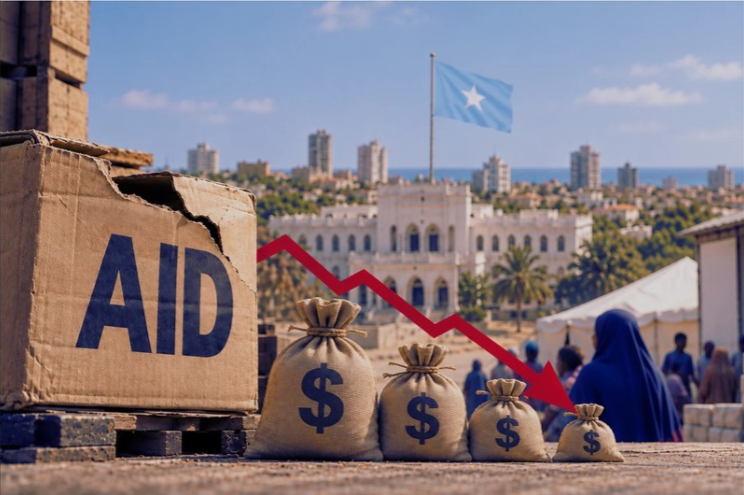
The 2025–2026 aid crisis represents the most significant fiscal and institutional challenge to the Federal Government of Somalia since the beginning of its post-conflict recovery. The abrupt withdrawal of USAID and the redirection of global Official Development Assistance (ODA) toward competing geopolitical priorities have exposed the inherent vulnerability of a state-building model that relies on foreign grants for 66.7 percent of its national budget. What was initially perceived as a period of fiscal expansion has rapidly devolved into a “survival stage,” where the state is forced to make impossible trade-offs between military security and the basic human survival of its citizens.
The scale of this “aid cliff” is staggering. With an estimated US$1 billion reduction in humanitarian financing and a nearly 74 percent cut to emergency appeals, the social safety nets of the Somali people have been effectively dismantled. The closure of 450 health facilities and the suspension of critical education programs do not merely represent statistical losses; they precipitate a “snowball effect” of socioeconomic deterioration that threatens to reverse a decade of developmental gains. Furthermore, the resulting service delivery vacuum creates a tangible risk to state legitimacy, providing a fertile ground for extremist exploitation in recently liberated territories.
However, as the Ministry of Finance has observed, this crisis also serves as a historic “opportunity to accelerate reforms” that place Somalia on a more self-reliant path. The government’s emergency response, including the doubling of the domestic health budget, the recruitment of 6,000 government-paid teachers, and the establishment of the National Disaster Management Contingency Fund—signals a fundamental shift in national consciousness toward fiscal responsibility. The strategic move toward diversifying international partnerships and intensifying Domestic Revenue Mobilization (DRM) through digital systems and natural resource leveraging offers a viable, albeit difficult, roadmap to fiscal sovereignty. The future of the Somali state depends on its ability to transition from a reactive recipient of unpredictable humanitarian aid to a resilient, nationally led development model. This transition requires the full implementation of the “HDP Nexus” approach and a sustained commitment to building domestic institutions that are financed by Somali resources and governed by Somali priorities. While the path ahead is fraught with fiscal strain, the current crisis has made one reality undeniable: for Somalia to survive and thrive in an increasingly unpredictable global environment, it must finalize the architecture of its own sovereignty and move beyond the era of perpetual aid dependency.
Aid Cuts in Somalia: Implications for Public Finances, Government Institutions, and Service Delivery
SPA_Research_Report_No_24_English
Share This:
Stay updated on governance and public services in Somalia!
Somali Public Agenda (SPA) is a non-profit, non-partisan, and independent public policy and administration research and action organization based in Mogadishu. It aims to advance understanding and improvement of public policy and services in Somalia through evidence-based research and analysis, dialogue, policy and service design, and training.
Stay updated on governance and public services in Somalia!